Augmented Reality and AI Copilots Signal the Next Era of Robotic Surgery
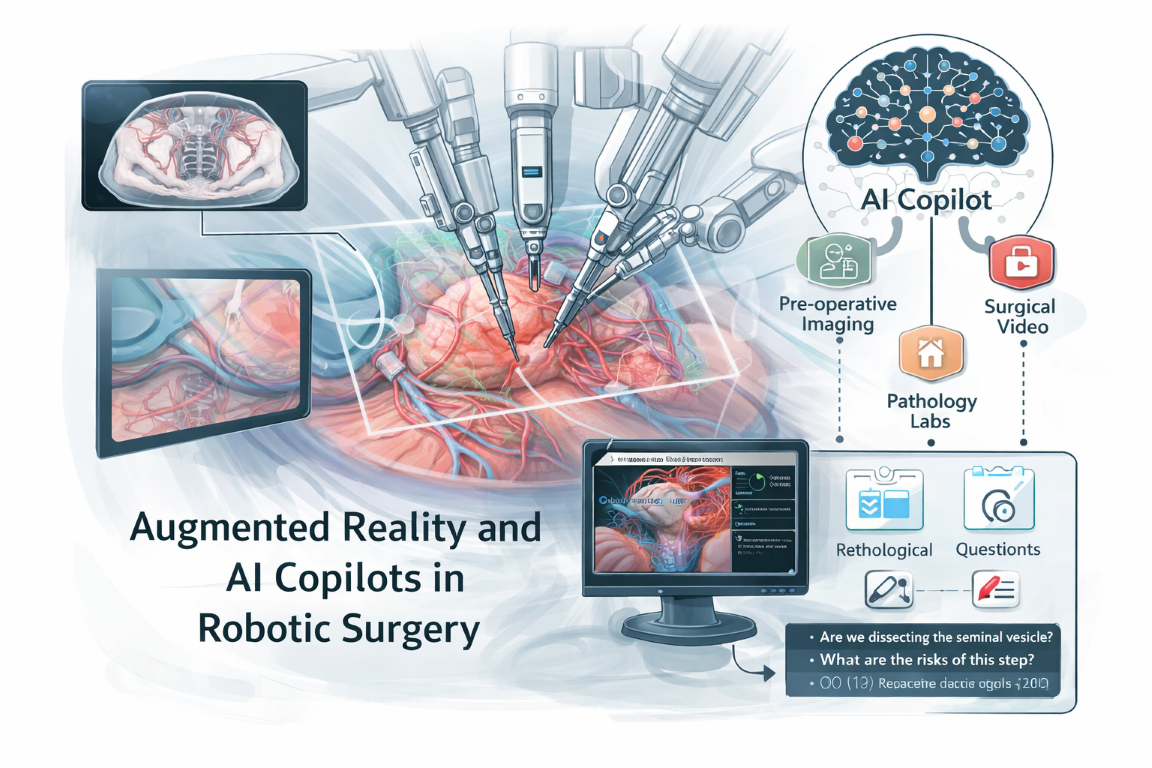
At the EAU Congress 2026, emerging developments in augmented reality (AR) and artificial intelligence are redefining the future of digital surgery. In a session focused on the integration of advanced technologies into robotic platforms, Dr. Pieter De Backer described how AR has evolved beyond simple visual overlays toward intelligent surgical assistance. Traditional AR aimed to project patient-specific 3D anatomical models directly onto the operative field, giving surgeons a form of “super-vision” that helps identify vessels, tumours, and anatomical landmarks during dissection. Recent breakthroughs—including real-time AI-assisted instrument de-occlusion and organ tracking—have significantly improved the safety and clarity of these overlays during robotic procedures.
However, the next stage of AR extends beyond visual guidance. Researchers are now developing systems that integrate multiple sources of information simultaneously, a concept known as multi-modal information fusion. These systems combine intraoperative video with radiological imaging, procedural knowledge, and patient-specific clinical data to provide context-aware surgical guidance. Powered by advanced vision-language models (VLMs), the technology allows AI to interpret both visual scenes and medical language. Instead of merely recognizing structures, such systems can answer procedural questions, identify surgical phases, and highlight potential risks during an operation.
One practical implementation discussed at the congress is the Surgical RARP Copilot, a real-time AI assistant designed for robot-assisted radical prostatectomy. Unlike earlier “narrow” algorithms trained for single tasks, the copilot is built on a foundation-model architecture trained on extensive surgical video, anatomical data, and medical literature. By analyzing the live operative feed, the system can recognize instruments, monitor surgical progress, and provide contextual insights during the procedure. Experts suggest that such AI copilots could function as a “cognitive safety net,” helping standardize surgical performance, accelerate training, and convert surgical data into measurable improvements in patient outcomes and healthcare efficiency