Breakthrough in Stone Therapy: Burst Wave Lithotripsy Takes Center Stage at EAU26
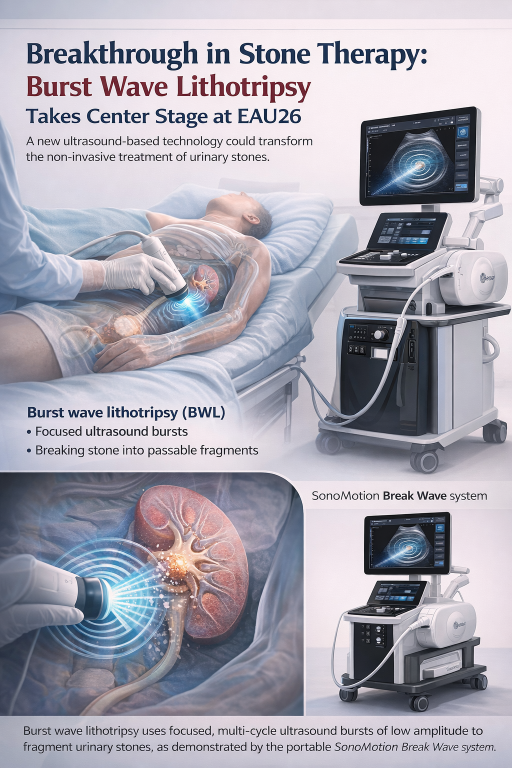
The future of kidney stone treatment may soon shift toward truly non-invasive therapy, as Burst Wave Lithotripsy (BWL) emerged as one of the most talked-about technologies at the EAU26 Congress held from 13–16 March 2026. BWL represents a departure from conventional extracorporeal shock wave lithotripsy by using focused, multi-cycle ultrasound bursts rather than single high-energy shock waves. These lower-amplitude acoustic bursts create internal stress waves within the stone, forming multiple “hot spots” that promote predictable fragmentation while minimizing tissue injury. The concept builds on decades of work in stone acoustics and cavitation physics, with Dr. Bailey and colleagues providing quantitative modeling and preclinical evidence demonstrating how optimized pulse parameters and beam profiles can achieve effective fragmentation while maintaining safety.
Clinical feasibility was first demonstrated in the landmark study “First-in-Human Application of Burst Wave Lithotripsy with Ultrasonic Propulsion” reported by Dr. Mathew D. Sorensen (University of Washington, Seattle) and collaborators. In that early experience, a 7-mm renal stone was fragmented intraoperatively within minutes, while a distal ureteral stone treated in an awake patient was successfully broken and passed without complications. Follow-up imaging confirmed complete stone clearance and no clinically significant renal injury. Subsequent intraoperative series by Sorensen, Harper, and colleagues showed that stones up to approximately 12 mm could be fragmented to passable ≤2-mm fragments in around ten minutes of treatment, suggesting that BWL may function both as a standalone therapy and as an adjunct during ureteroscopy.
The strongest clinical evidence to date comes from the international “Break Wave Trial” (NCT03811171) led by Prof. Ben H. Chew (Vancouver Prostate Centre, Vancouver General Hospital), which evaluated the portable SonoMotion Break Wave system in 44 patients with renal or distal ureteral stones. The prospective study demonstrated 92% successful stone fragmentation, with 75% of patients left with fragments ≤4 mm and 58% completely stone-free on follow-up CT. Notably, distal ureteral stones achieved an 89% stone-free rate, comparable to ureteroscopy but without the need for anesthesia or ureteral stenting. Researchers also highlighted the complementary role of ultrasonic propulsion, which can reposition stones and accelerate fragment passage, potentially allowing treatment in outpatient clinics or emergency departments. Together, these findings position BWL as a promising technology that may bridge the gap between conservative management and operative intervention in modern stone care.